Megan and her dog, Nika, came home for the holidays, much to our delight, but Noah was particularly pleased. It meant he could run on the wild side again, that he could indulge in his wildest fantasies – squirrel! – with his sister and best bud, Nika. It meant he and Nika could spend a few hours on the porch at night when Rob fell asleep on the hammock and the door would be propped open for them just in case squirrels dared to scramble through the mango and avocado trees.
Their days usually begin on that porch if Rob is out there or on the family room couch, where they sleep butt to butt, or in our bedroom, where they sleep cupped like spoons in a drawer. They often wake up Rob before the sun rises, nudging him with their cool, moist noses, asking if the porch is an option, please oh please.
Once Rob gets up, they prowl around the kitchen, hoping some morsel of his breakfast drops on the floor. Or they head out into the backyard to chase each other, hunt lizards and squirrels and then run into the house with old bones they’ve dug up. They don’t worry about paying bills, when they will eat, or about much of anything else except – where’s Rob? He’s the Preferred Human for them, the guy who tosses the Frisbee or a ball. When he does this in the front yard, it’s a special treat – because our neighbors’ dog, Fergie, might magically appear, wriggling and racing and ready to romp and play!
When we go to the gym, they go along for the ride and spend a restful hour in the backseat of our car. We usually park in the shade of a tree, so perhaps they watch for birds and squirrels. Maybe they sleep and dream. I don’t know because I’ve never hung around to observe them.
But when Rob and I return an hour later, they are happy to see us and Nika perches on the console between the two front seats and helps Rob drive. And yes, this is pretty shameless for a synchronicity blog, but hey, sometimes we detour.

Noah often tries to nudge himself into this same space, but he’s such a large dog (100 pounds plus) that he usually manages to maneuver just his big head on the console, below Nika’s belly. On the days that Rob goes biking with a friend, I walk out into the kitchen and see the dogs curled up together on the couch. As soon as Nika sees me, she tears into Rob’s office and leaps, barking, at the door, to be let out.
In this way, she is very much a focused border collie. She nearly always follows the same path out that door, curling behind some bushes that parallel the fence, her path now so worn into the ground there’s an actual groove. She leaps up at a nearby tree where once upon a time she saw a cat, hiding, and at this point, Noah will often join her. From the mysterious tree that once harbored a squirrel, the two of them sniff their way through the jungle of our yard, and finally return inside the house for another nap.

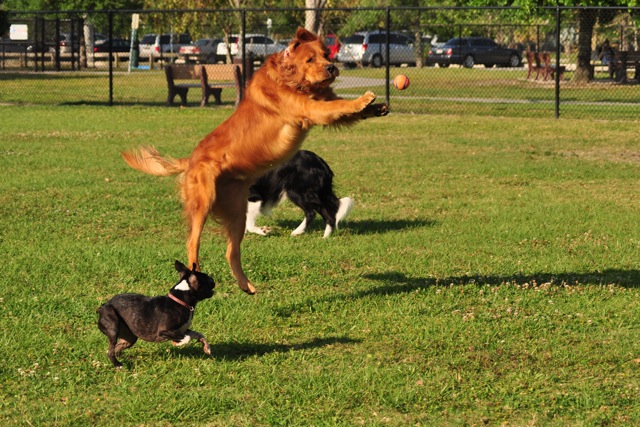
These two always know when it’s time to go to the park. Between 3 and 4 p.m., they get antsy, and Noah leads the way by coming into my room and nudging me with his big snout. Pay attention, Trish. It’s time. When I say that word, park, it’s as if I’ve actually uttered the truly magical word squirrel. Noah howls, Nika barks, out come the leashes, and suddenly, we are all there, pulling into a parking space at the dog park.
Nika often whimpers and barks before we even open the doors. I grip her leash so tightly my hand aches. Noah often gets away from Rob and tears across the parking lot – then stops and looks back at Nika. Well, you coming or not, slow poke? Meanwhile, Rob is telling Noah to come over to him, his voice stern and loud, and Nika is practically pulling my shoulder out of joint. Quite often, I just let go of her leash and she races after Noah.
And always, it’s a moment to savor – even though it violates all the dog park rules. They move with the wind, these two. They try to climb trees that hold squirrel scents. Their leashes flap along the ground as they race each other from one tree to the next and finally to the dog park gate.
In the holding area between the free world and the fenced dog park, we remove their leashes. Nika, whimpering and barking and chafing at the bit, is trying to dig her through the gate. Noah is howling. Then I throw open the gate…
… and they are gone, already at the far end of the park, where the trees are known to harbor squirrels. Symmetry and grace are their hallmarks, they are fully immersed in the moment, in the omnipotent now, and Rob and I are merely caretakers. But in the end, isn’t that what we actually are for our animal companions? And for each other?
In the end, dot; we all end up like this, eager to seize – well, if not squirrels, then something else. My new year’s resolution for 2014 is taken from the lives of dogs: I am determined to live more in the moment, the eternal NOW, and to have goals that prompt me to seize that moment.
And I also resolve to give gratitude about the parts of my like that work beautifully:
 Happy 2014 to everyone!