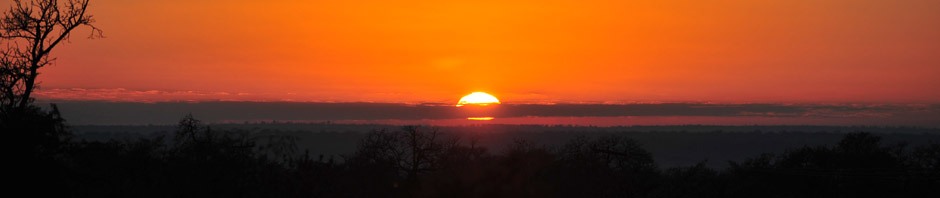
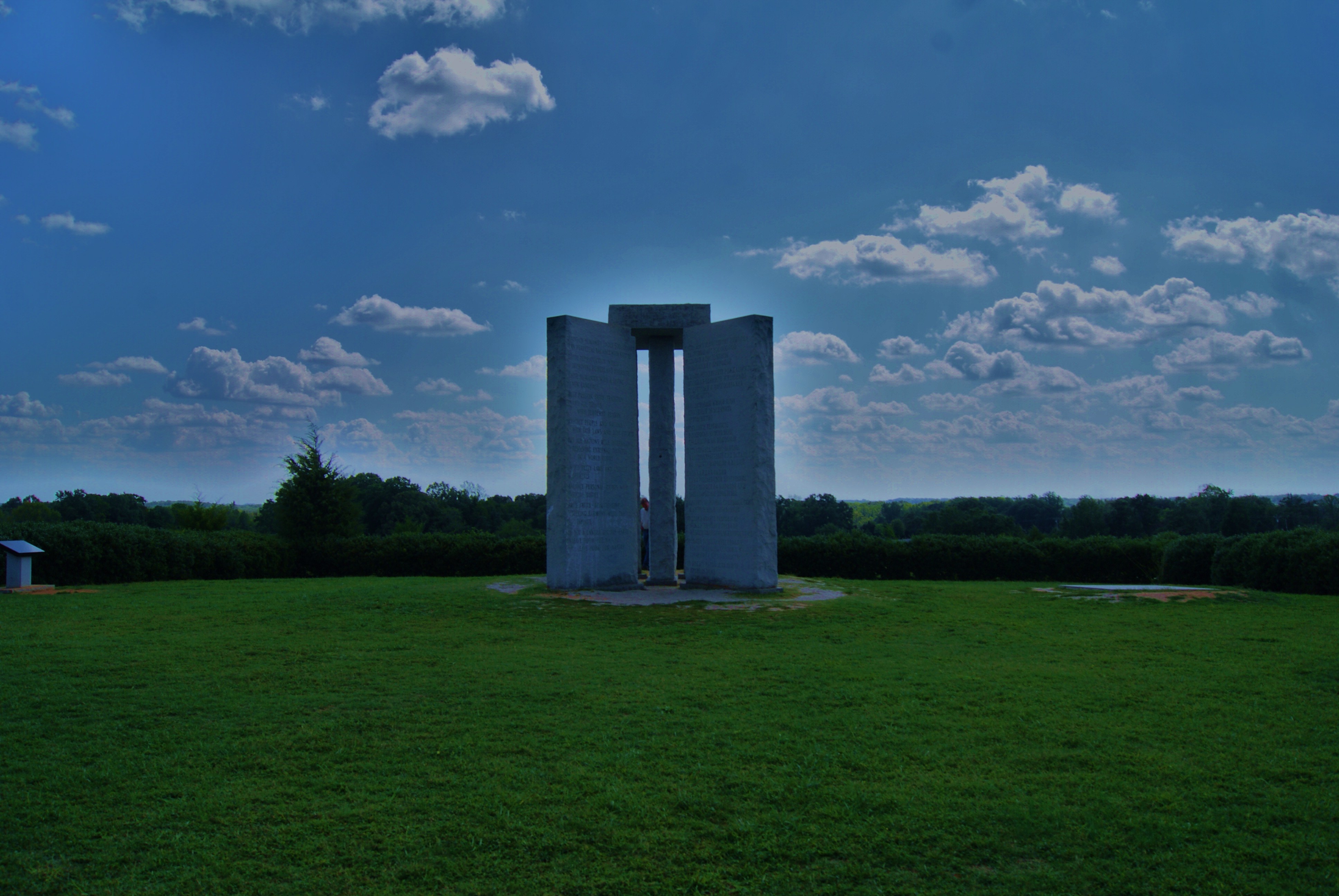
Here’s the second part of Connie’s story. If you look closely at the photo above, you’ll see a halo around the Guidestones and also above the distant landscape. How this photo came about is part of the strange scenario that occurred at the mysterious site.
+++
On with my experience…..Both sons were already walking around taking photos from various angles. Kenny has a professional camera but did not at any time change the lens or adjust the light meter on his equipment. I had specifically asked him to keep everything unaltered other than to zoom in and out as he needed to do that.
I left the vehicle and went to read the time capsule plaque, walked around the Guidestones, then read the history. After that, I found the stone with the Egyptian language engraved upon it, and placed my palms against the granite.
It seemed to throb into my palms with some kind of pulsating energy, so I pressed the front side of my body against that stone, including the tips of my toes and my left cheek. I also pressed my palms and forearms against the stone on either side of my head. I closed my eyes. The stone throbbed and pulsed. It wasn’t my heartbeat. The sensation was definitely coming from the stone.
I couldn’t pull my body away from it. It seemed as though there was a magnetic force, or energy, that held me against that rock the way a magnet hold a piece of paper on a refrigerator. I didn’t resist because it felt good, not frightening. I felt as if I couldn’t speak and didn’t try.
But our three-year-old, mimicing Grandma, put his tiny body against the center stone with his little arms stretched out against it, and he shouted, “Mommy, Mommy! It’s a drum!” I’m sure he was feeling the throbbing and pulsing.
The granite was hot, although the day was chilly. However, there was full sun which could account for the heat. I simply stayed there flat againt my Egyptian pillar until the heat and the pulsing gradually ceased. When it stopped, it was as if a switch was flipped and my body, of its own accord, released from the stone. I felt very light-headed and slightly dizzy; the throbbing and pulsing seemed to have transferred to the interior of my head.
I started back to our vehicle so I could sit down and wait for the others. If I hadn’t had a tall walking cane, I would have fallen to the ground. As I neared the SUV, a white pick-up truck drove up and parked in the adjacent space on the passenger side. The pickup was new and unmarked as if it had just left the dealer’s lot. The driver got out, nodded at me, and leisurely walked towards the stones.
This fellow was about 38 or so years old, with very pleasant, attractive clean-cut features, sandy-blond hair and a nice haircut. He was perhaps 5’11” to 6′ tall, broad shoulders, an athletic body. I sat in my vehicle with the door open, and watched him. He wore jeans and a white polo shirt. I somehow knew it wasn’t his first visit there. With his hands in his jeans pockets, he meandered to the time capsule, stood there a few minutes as if reading the engraving, then made a slow circle around the stones. He looked at the historical plaque, then leisurely circled the stones again. I watched him closely.
Meanwhile, both sons continued to snap pics. Hubby eventually came and sat beside me in the driver’s seat and the youngest son and his family got in their van. Kenny was snapping his final pics as the fellow passed him on his way back to the pickup truck.
The stranger half-smiled at me. I smiled back and said, “Interesting, aren’t they?” He responded, “They are.” I said, “I’d love to know who really had them constructed.” He grinned and said, “Maybe Donald Trump.” I shook my head and said, “Trump isn’t spiritual,” then added: “Some of the researchers say RC Christian took his pseudonym from a founder of The Rosicrucians.”
The man leaned towards me, pierced my eyes with his, and they were the most startling, extraordinary shade of shattered-crystal gray-blue. They were penetrating, mesmerizing. I couldn’t move my eyes from his. In a quiet voice with just a slight smile, he said, “Maybe aliens.” I responded, “Yes?” He held my gaze and said, “This could be a landing space for alien craft.” Then he broke the intense gaze and got into his pickup.
Unfortunately, I wasn’t able to see his license plate because for a few moments I felt ridiculously paralyzed and couldn’t move my head, even though I desperately wanted to. There was absolutely nothing about this man to suggest craziness or any kind of off-the-wall nonsense. Just your average Joe? Uh-uh.
Kenny was in the backseat by then, and as we drove away, heading north once again, he began to download the photos onto his laptop. We’d driven a few miles when he suddenly exclaimed “Oh my God, Mom!”
“What? What?” I asked. He handed me his laptop and pointed to two photos he’d taken after the stranger had walked around the entire knoll. In those two photographs, the entire scene has a brilliant almost sapphire blue cast to it, and the Guidestones are emanating a wide light blue energy aura! That energy aura is also emanating from the hedge all the way around the three sides of the grassy knoll. It’s unmistakable. And there is a vague cloudy haze behind the knoll in the sky where there had only been normal mid-day clear sky. Kenny did not do anything whatsoever to alter his pictures. He didn’t shift his light meter or change his lens. He simply kept snapping pictures.
I couldn’t believe what I was seeing. The spectacular blue tone of the entire scene, but the aura…or energy force….or whatever the heck it was….is astonishingly clear.
Who was that person? Both my sons and my daughter-in-law were taking pictures with their different cameras, and not one of them caught an image of the man although he was all over the place moving in and out of their view-finders. Say what? We have no picture of him, but all of us saw him, spoke to him, and I actually had a brief conversation with him!
I won’t attempt to explain the obvious shift that occurred on that knoll as he walked there, and the effects left on the photos. I’ll leave it at this, and let everyone decide what their own intuition may say. I know what mine tells me, and am anxious to hear from others.
+++
I asked Connie if Kenny was using a polarizer filter. Such filters are used to enhance the blue sky on bright days to avoid a washed-out look. One twist of the filter could darken the sky. However, I don’t know if the polarizer filter would cause the halo effect. Regardless, Connie responded that Kenny was not using a filter on his lens.
As an aside, I looked over the post late last night, made a couple of minor changes, then hit the update button. The story vanished and never re-appeared. So I retrieved the original e-mail and reconstructed it. That’s the first time a post has vanished like that. – R