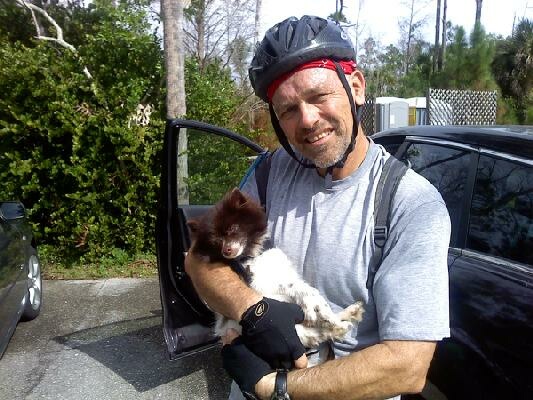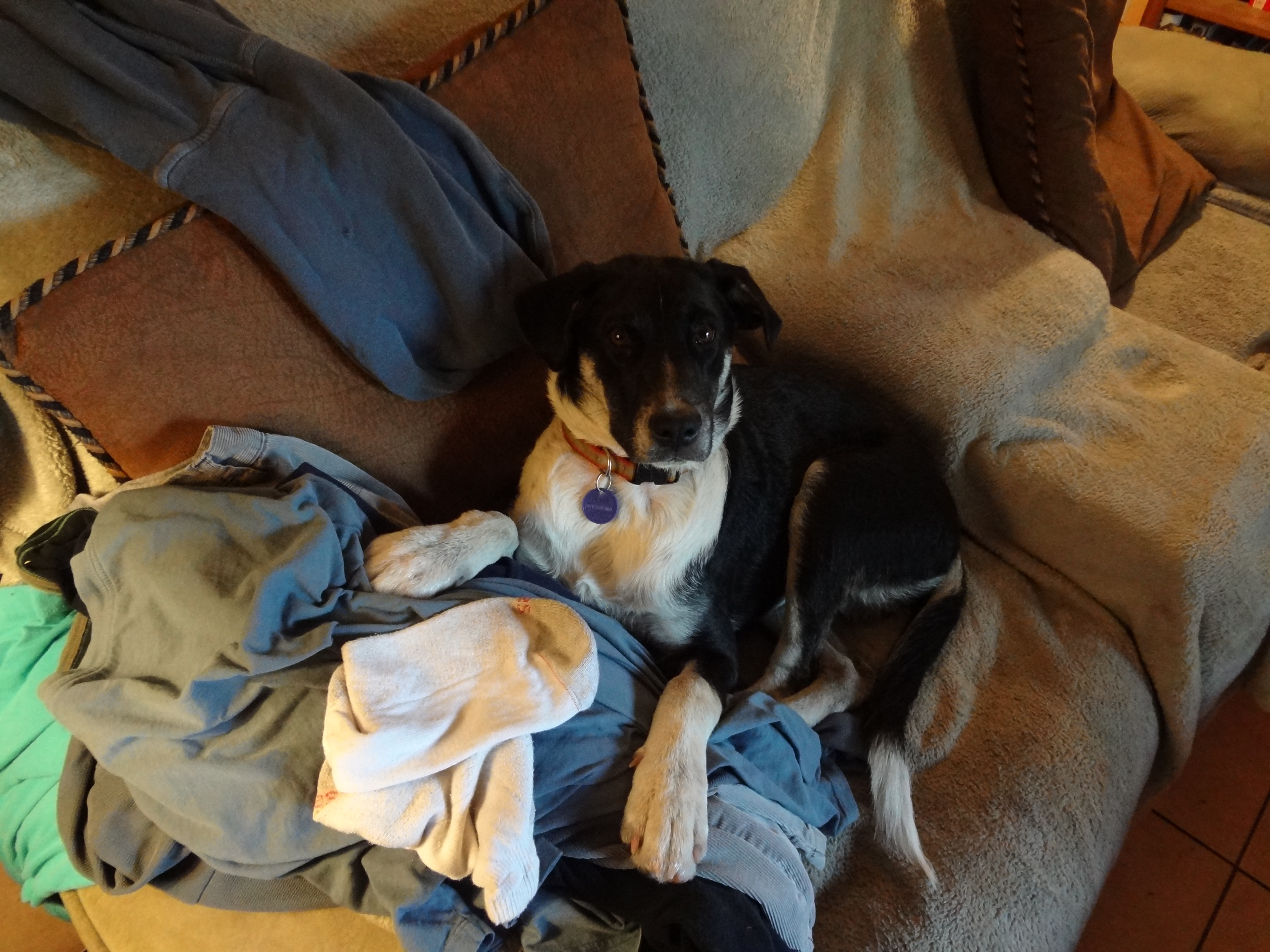

Today, Rob and I took a break and went biking with the two dogs out at the Grassy Waters Wilderness Preserve, the place where he had a lost dog synchro. I hadn’t been there before and was eager to see it.
My first impression was that the preserve is truly old Florida, the way the state looked before everything was developed and paved over. The paths were shaded by palmetto trees, scrubby pines, and the odd cypress trees whose roots protrude everywhere, little knobs of wood that stick up out of the ground, like dislocated elbows or knees.
Rob’s bike navigated the damp and sometimes muddy path much better than my bike – which is intended for solid ground, smooth sidewalks. At one point, he and the dogs were well ahead of me and I was coming around a sharp, wet corner and slammed down the tail end of what I think was a snake. It whipped away from me, and I was so freaked out I didn’t stop to go back for a look. I shouted, “Hey, I think I just ran over a snake, Rob!”
“It’s not a snake,” he called back. “It’s a palm frond.”
No way, I thought. Palm fronds don’t slither and whip from side to side as they move. Just in case I was right, that I had actually run over a snake, I held an image of it in my mind and apologized. I’m no fans of snakes, but the idea of injuring or killing one is abhorrent. I recalled how years ago when Megan was small and we were living in another house, I walked out into the living room one morning and found what I thought was coral snake, coiled in the middle of the floor, with one of the cats dancing around it. I scooped up the cat and shut her in one of the bedrooms, then ran back into the living room, shouting for Rob to come take a look.
There’s an old saying about how to tell a coral snake from its non-venemous doppelganger: Red to yellow, kill a fellow; red to black, venom lack. The snake in the living room was red to black. Using a broom, Rob got it into a paper bag and released it outside. Not long after this incident, we got a contract for a writing project. So my thought about this snake was that good news of some sort was on the way.

Considering how wild this preserve is, with vast stretches of open wetlands that we crossed on wooden boardwalks, like the one in the photo above, followed by dense foliage and trees, I had expected to see gators, wading birds, deer, hawks. But the only other wildlife we saw was a squirrel, which the dogs spotted first. In retrospect, the absence of other wildlife seemed as significant as the snake.
So when we got home, I started Googling snakes as totem animals. The snake symbolizes fertility, rebirth, transformation, healing. Traditionally, the squirrel gathers up the food it needs to survive winter, so the esoteric meaning is about preparation, ridding yourself of what you no longer need – physical stuff, but also negative beliefs. In South Florida, winter consists of a few weeks now and then between November and February and this year, we’ve had maybe two days of temps in the forties. So I decided that the squirrels out in the preserve may have a different esoteric meaning altogether.
About an hour after we got home, we got an email from a woman who works for William Shatner’s show, Weird or What? We had been corresponding with her since late January, when she sent us an intriguing email: Could we give her a number where she could call us so we could talk about the Pauli effect?
So we’re going to be flying to Toronto for an interview on Weird or What? and will have a chance to talk about Pauli – and synchronicity. There’s a certain irony about the name of the show. For years, Rob and I felt like the weirdos in the universe because of our beliefs. Perhaps the trickster is at work here?
Here’s a segment from Weird or What with Whitley Strieber.