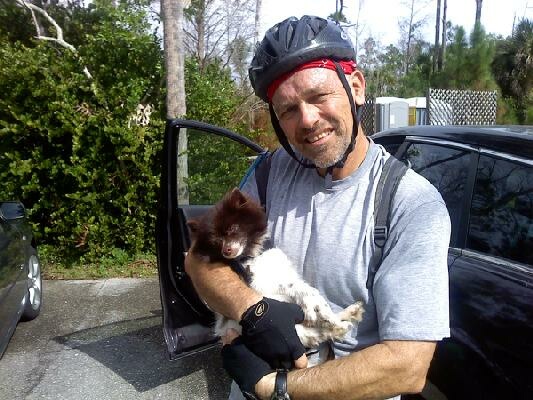

Super Bowl Sunday found me out on a trail ride in the morning in Grassy Waters Wilderness Preserve. The bike trail covers about 18 miles and it was the first time my friend Tacayo and I had explored the preserve. At the head of the trail, the sign said watch for alligators, bobcats, raccoons, opossums, and feral pigs. We saw none of them on this beautiful woodlands and wetlands ride. But we found, of all things, a lost Pomeranian.
We had been riding for about 45 minutes and hadn’t seen a single person when we spotted a small furry creature on the trail about the size of a baby raccoon. Only it was a tiny dog with a lion’s mane. It was running towards us. We stopped, the dog stopped, then spooked and raced past us along the trail.
We figured its owner was nearby. But after riding ahead a couple of hundred yards and not seeing anyone, we realized the dog must be lost. We turned around and pedaled after it. If we were hiking, we never would’ve caught the dog. As it was, we backtracked half a mile before catching up. Again it stopped. Tacayo offered the pooch water. It turned tail and ran off again. We remounted and gave chase. This time we corralled the dog, a bike across the trail on either side, and I snagged its doll-sized harness.
Once in my arms, the little guy turned passive. I was able to ride with him in one arm as we continued on. Unfortunately, the dog had no collar or tag. I was hoping it had an implant ID that a vet could find.
After a couple of miles, I noticed a housing development across a canal and behind a high wire fence. We rode another quarter mile when I spotted a woman and child in their backyard. I stopped and asked if she knew anyone who had lost a dog.
She looked up and said, “Oh my God. That’s my neighbor’s dog. There are signs up all over the neighborhood. He’s been missing two weeks.” I got directions on how to reach the entrance to the development and she promised to meet me at the gate.
We rode on another twenty minutes and just as we reached the parking area, I hit a root and lost control of the bike. I rode into some shrubbery and managed a gentle fall that protected the dog, which never even flinched in my arm. After being lost for so long, it seemed as if it was ready for anything.
A few minutes later, we drove off and met the woman and the owner who were both waiting at the gate. The owner shouted, “Scooter! I can’t believe it! You’re alive.” He was ecstatic and explained how the dog had escaped through an open door, and he’d given chase but couldn’t catch him. He wanted to give me a reward. I said no thanks, but that he could play it forward and pass on the favor to someone else in need.
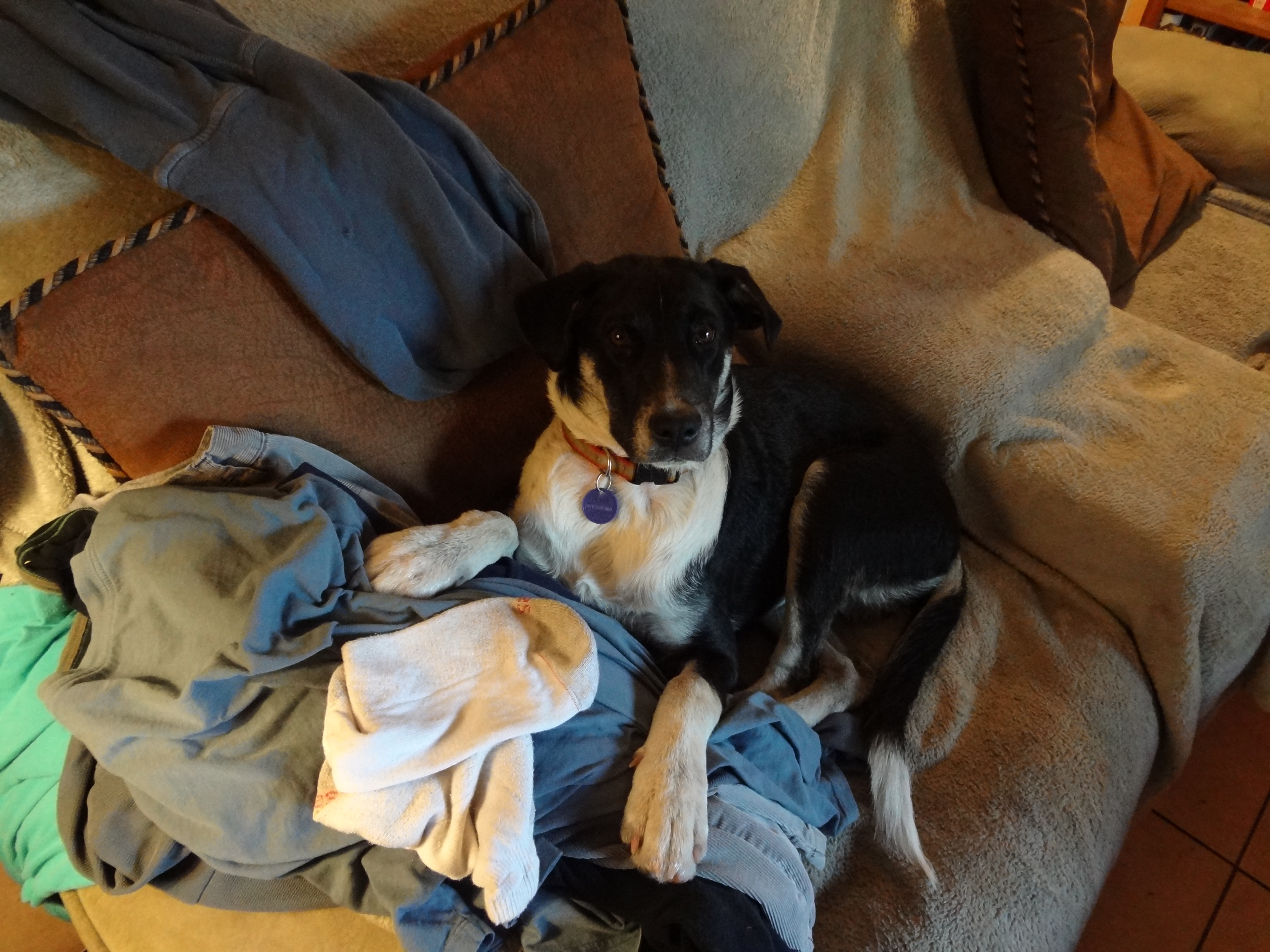
It still seems really remarkable that we found the owner. Definitely a synchronicity. But there’s another synchro involved in this story. When Megan adopted a puppy a few months ago, she was very curious about its breed. It looked like a smooth-furred border collie with all the right markings. But its head was not as narrow as a border collie, it had webbed feet like a lab, and we thought it might be mixed with a lab.
So we took a DNA swab on the inside of its cheek and sent it out for analysis. When the results came back, we were stunned and puzzled. The lab gave us three generations – great-grandparents, grandparents, and parents…and they were all the same mix. A pomeranian and an Australian kelpie.
Well, Nica looks nothing like a pom and we had to look up pictures of kelpies. They resemble medium-sized shepherds with pointed ears. Nica has floppy ears and doesn’t look much like a kelpie, either. We decided the results were bogus. But for the past months, we’ve jokingly referred to Nica as a pom. In fact, the Pomeranian has become the default dog at the dog park. So it was somehow fitting that I encountered that particular breed lost in the preserve. A super Sunday.