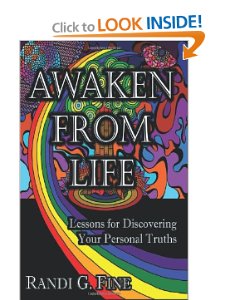

We like to plug other authors who write about synchronicity. That’s the case with Randi G. Fine, a radio talk show host in Fort Lauderdale, Florida and ‘relationship dependency’ counselor. She’s also an author and her new book, Awaken from Life: Lessons for Discovering your Personal Truths, includes an interesting chapter on synchronicity. She suggests that the amount of synchronicity that you attract into your life is proportional to your own level of awareness.
Here’s an excerpt.
Synchronicities occur much more regularly than most of us are aware. They often go unnoticed because the signs represented to us tend to be symbolic in nature and need deciphering.
Often we find that the timing of these messages, people, and things relate directly to current issues in our lives or information that we are presently in need of.
Think about your life and the amazing ways that things have come together for you: the chance meetings with people that reveal just the information you had been looking for; the trip you took to a foreign country where you ran into someone you knew; the song that came on the radio at the exact time that you needed to hear those words; the book given to you by a friend that sent you on a life-altering spiritual quest; that certain number that pops up wherever you go; or the person you ran into that offered the healing solution to your illness.
Each day we attract “meaningful coincidences” that are there to give us direction. The amount of synchronicities we personally attract is proportionate to our level of conscious awareness. The more attention we pay to these awe-inspiring “coincidences,” the more frequently they will occur.
Whether believer or skeptic we have all experienced these seemingly random occurrences that seem too improbable to be chalked up to just chance. Coincidence or synchronicity, both fascinating phenomena, are uncanny and appear unexpectedly.
How many times have you heard someone say, “There are no coincidences, in response to one of these baffling occurrences? Perhaps you even use the phrase yourself.
To understand why these incidents are not coincidental you must first understand what a coincidence is. Coincidences are experiences where two events coincide that have no relationship to each other. Some sort of pattern or connection associated with the coincidental experiences can be derived, but an obvious explanation for their occurrence cannot be found.
There are skeptics who say that these phenomena are coincidental; that a connection between the experience and one’s reality is merely illusory or selective perception.
Statisticians fall into the skeptic category. They believe that these types of occurrences are not phenomena at all—just manifestations of the law of averages. They say that coincidences are inevitable; with five billion people on the planet there is a reasonable probability that unlikely circumstances of this nature will happen. To quote mathematician John Allen Paulos, “The most astonishingly incredible coincidence imaginable would be the complete absence of all coincidences.”
There are those who follow the supernatural theory of synchronicities but offer different, spiritually based explanations on the matter. They attribute these experiences to karma, fate, or destiny. Some say the experiences come from angels or spirit guides showing us signs that guide us in the direction of our soul’s purpose.
None of these explanations are inaccurate. All these facets of spirituality and supernatural activity are likely to factor into the occurrence of synchronicities.
We recognize a number of spiritual occurrences through our intuition. Those of us who are open and receptive to embracing faith based realities tend to be most in touch with our intuitive, inner knowing perceptions. By paying attention to our inner guidance, we are more likely to know what we are seeking and can more easily recognize the signs that direct us to it. It is our acceptance of intangible realities that allows us to recognize the many synchronistic occurrences that happen to us.
Intuition and synchronicity are interconnected in such a way that it is hard to distinguish where one stops and the other begins. The more synchronicities one notices the more intuitive one becomes; the more intuitive one is the more synchronicities they are likely to recognize. The more awareness one has of his intuition and the synchronistic occurrences happening around him, the stronger his connection to universal energy and knowledge becomes.
Think of synchronicities as communications from the Universe that are there to keep you aligned with your purpose. These signs are indications that your inner world is in sync with your outer world.
The more you believe in the miraculous nature of synchronicities, the more you will notice and experience them. By developing an awareness of the many synchronicities that occur in your life, you will gain the understanding that everything that happens in your life happens for a reason, whether or not the reason reveals itself at the time. You will awaken your spiritual journey and find your life flowing in wonderful ways.
Synchronicities are awe-inspiring, though not all of them play out the way you may hope for. As you experience more synchronicities in your life, try to keep a positive attitude, especially when you are confronted with a seemingly negative outcome. Do not despair. A negative outcome is often put before you as a tool for learning and growing, and may ultimately lead to a positive outcome.
It is important to remember that every event in your life, whether positive or negative has a greater purpose. A lesson that does not turn out the way you would like it to, is simply a lesson that turned out the way it was supposed to. Make it a practice to accept the natural flow of life.
In times of uncertainty, disquietude, and transition synchronicities give us direction. They guide us as we spiritually evolve in the physical world. They are signposts, sometimes subtle sometimes obvious, showing us the most direct route to take, the easiest path to follow, to fulfill the purpose we are here for. They put us in the right place at the right time to cross paths with others who have meaningful messages for us.
We all have stories of how we met the loves of our lives or our best friends, found a new career or the perfect job, began a spiritual path or met the perfect spiritual leader, and discovered we had an illness or unlocked the mystery of an elusive ailment. In more cases than not, a synchronistic experience was involved in that life changing event.
My life story, as told in my memoir Fine…ly, was a series of synchronistic events that led me through a significant amount of pain and adversity, but ultimately delivered me to a place of serenity and joy.
The same can be true for you. By awakening to synchronicities, having patience, and trusting the perfect guidance of the Universe, you will fulfill your purpose for being here.
Be mindful of what happens around you. Through this conscious awareness you will ultimately achieve the loving, peaceful quest of your soul.