Sometimes you travel to a place and something happens that defines the core of your journey. It might be anything – a conversation with a stranger, a view that captures your soul, an animal that shadows you on the way back to your lodging, a particular food you sample, a dream, a vision, people you meet. For me and my introduction to Costa Rica, that special something was Stephanie, the macaw.
I think we first saw her when we were several miles from Arenal Lodge. We had stopped to take photos, each of us heading off in different directions – into trees, to the lip of a cliff – and a light rain was falling. Megan and I ended up in the same spot at some point and we heard the bird’s cries and looked up.
Up high in the trees, sixty or seventy feet up – a bird with a long tail circled through the mist, its cries hauntingly eerie. “It’s a Quetzl bird,” I shrieked.
“What’s that?” Megan asked.
Well, okay, where did that conclusion come from? Something I’d read, no doubt about the rare Quetzl bird sighted in certain parts of Costa Rica.
Megan got out her camera with its zoom lens, but the bird was simply too high to see clearly. When Rob joined us, he took a look and shook his head. “I can’t see it well enough to tell what it is,” he said.
We drove on through the mist, reached the lodge, checked in. That evening before dinner, we stopped by the bar for a drink. It was dusk, the bar was as open as the rest of the lodge, the cool mountain air flowing in. And then we saw it, the Quetzl, shrieking, crying out, making a wide sweep again the hallucinogenic sky. The bird finally settled at the edge of the bar and the bartender quickly cut up some fruit, put it on a plate, and set it on the window for the most beautiful blue and green macaw I’ve ever seen – and I’d never seen one outside of a zoo.
“Who’s that?” I asked.
“Stephanie,” he replied.
Uh-oh. He had named the bird. When you name a creature in the wild, it means there’s some anthropomorphic stuff going on. You know, the same sort of exchange that occurs daily with the animal companions who share your life. Except that Stephanie was wild. The bartender, who fed her daily, couldn’t touch her. No one could touch her. But she knew where to come for her fruit plate, her sugar water, to pose for photos. Then I remembered that the only macaw native to Costa Rica are the red variety, not the blue.

“She’s not doing too well,” the bartender said. “Her mate was killed a few weeks ago. They mate for life, you know.”
For the next three days, every staff member we talked to about Stephanie repeated the same story. Apparently Stephanie and her partner were brought to Costa Rica from Brazil, by the woman who owns the lodge. The owner is Canadian, was married to a Brazilian, and when he died, she inherited the lodge and its 2,000 acres. From what we understand, Stephanie and her partner arrived about six years ago and were set free on the property.
The male was apparently the friendlier of the two, the more trusting, the one who allowed humans to stroke his feathers and who would eat from your hand if you offered something delectable. One day, he was in or near the closest town of La Fortuna and pecking at some shiny stuff on a car. The owner freaked and hurled something at the male. In Spanish, the word for this is golpear – a violent blow– and that blow killed him.
I was so horrified by this story that I plied the bartender with questions. Was this person male or female? A tourist or a local? How did the lodge find out about it? The person who did it was apparently a male tourist. The macaws were well known in the area and a local brought the bird’s body to the lodge and explained what had happened.
“She mourns,” one waiter told us.
“She isn’t like she used to be,” another employee confided.
Megan, of course, kept trying to get Stephanie to take a piece of fruit from her hand, but Stephanie wasn’t having any of it. Megan did get close enough to run her fingers across Stephanie’s tail feathers.
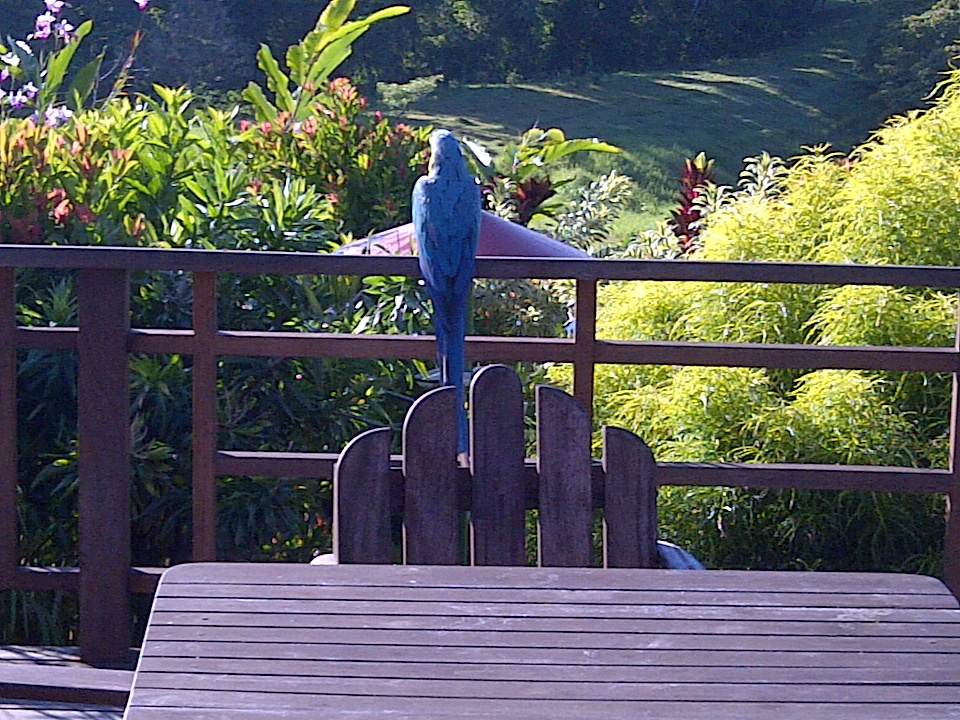
Every evening after Stephanie had sampled the delicious fruits and sipped from her glass of sugar water, she would flutter over to the railing and gaze out at the volcano, at the utter lushness of this place. She was listening, watching, alert. You could see something in the way she held herself, body tense, vigilant. I always had the feeling she was waiting for her mate to return.
Rob asked what the synchro is and I can’t find one. But there’s a deeper meaning here. Really, look at that photo, the bird alone on the railing, the only one of her kind in the entire country (so the employees said), facing the dusk and the impending darkness by herself. Stephanie’s story resonates with the more profound elements in human life, that of loss and redemption, and a hope that perseveres.