This is an interesting video. It’s supposedly real. Maybe Salandar – the protagonist of Steig Larrson’s trilogy – is alive and well in NYC.
This is an interesting video. It’s supposedly real. Maybe Salandar – the protagonist of Steig Larrson’s trilogy – is alive and well in NYC.

The next synchro appeared as a comment under Graduation Signs, from Aussie Darren B, whom we know as Brizdaz.
In the post, Rob had mentioned “signs,” and this led to Brizdaz’s very cool synchro:
+++
Talking about the movie “Signs”, I was like you. When I saw it at the cinema the first time I wasn’t that impressed, as far as the alien story went, anyway. But when it came out on to DVD, a national magazine in Australia was having a competition where one winner would get a “Signs” wristwatch and a copy of the movie on DVD. Ten runners up would receive a DVD, but no watch.
Like you, I felt for some reason that I should watch the movie again, so I entered the competition thinking that if the Universe really wanted me to watch this film, then it should let me win the watch…as a sign, so to speak. I thought, What are the odds of just winning a copy of the DVD, never mind the watch, as well?
Well you probably guessed it. I did win the watch. And I still wear it to this day.
It’s gone through a few batteries and a wristband, but every time I put it on, I never forget that it was my sign from the Universe. And I’ve watched that movie countless times and never get sick of it.
+++
Then Brizdaz sent us a photo of the watch!
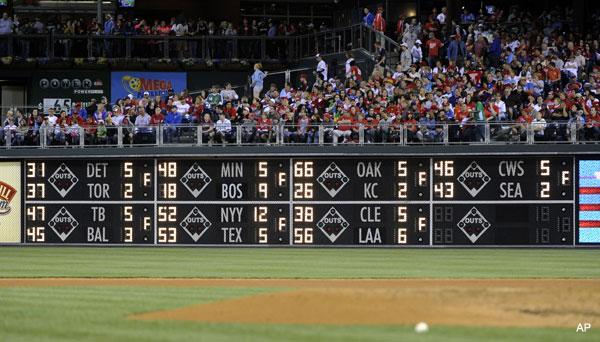
Here’s a number cluster from the world of baseball that occurred on Sunday May 8. The writer of the article below calls it a ‘meaningless serendipity.’ Well, besides confusing synchronicity with serendipity, he created an oxymoron since by definition serendipity – like synchronicity – is meaningful. So he should stuck with coincidence. But then he’s a sports writer and they like to add some flare to their prose.
If you look at the sign, you can see that every score contains the number 5–the first time that has happened in a zillion games, or something like that. Some 5’s were winners, others losers.
Here’s the article, and more commentary to follow it.
+++
Warning: If you’re not into the ultimately meaningless serendipity that baseball numbers can often provide, this post isn’t for you. But if you love those days on the schedule when everything aligns for no reason whatsoever, well, please read on.
On Sunday, each of the seven games on the American League schedule featured a team that scored exactly five runs — four winners and three losers. The rarity almost didn’t happen either as the last game of the day featured the Chicago White Sox needing to score three runs off the Seattle Mariners in the 10th inning of their 5-2 win.
It was the first time in 18 years that such a quirky thing happened with a full schedule. On Aug. 10, 1993, all seven NL games featured one team scoring precisely two runs, STATS LLC said.
The last time it occurred with five or more runs was July 20, 1955, when all four AL games had at least one team score exactly six, STATS LLC said.
To channel Mr. Double Rainbow: What does this all mean?
The answer, of course, is absolutely nothing, though it did make me think of that old “Five Alive” drink and marvel at how awesome that orchard runoff tasted when I was a kid. Mmmmm, sugar.
+++
Okay, Mr. Sportswriter, you did find some personal meaning to the number 5 with your Five Alive, though in the same breath you say those 5’s mean ‘absolutely nothing.’
But why not take another look. For the fun of it, let’s interpret this cluster of 5’s as a message to Major League Baseball. Here is what 5 means in numerology, courtesy of Sidney Omarr, the late-great numerologist and astrologer, whom we have been ‘channeling’ for eight years.
Freedom of thought and action are key. But so is moderation; avoid excess in whatever you’re doing. It’s time to promote new ideas, follow your curiosity. Be versatile and changeable, but be careful not to diversify too much.
Get ready for change. It’s time to seek new horizons. Release old structures and get a new point of view. Be courageous and adaptable. Approach the day (the game) with an unconventional mindset.
A change of scenery works to your advantage. You (a team) could be moving to a new location. Finally, think outside the box. In baseball, that could include the batter’s box (the players), the box seats (the fans).
Not being an ‘inside baseball’ guy, I don’t know how much of what I wrote applies. But there might be some nuggets there…or an overall picture.
Play ball.

Do you ever wonder how people find your blog? What search terms lead them there? This area intrigues us, so we looked back through the last 2,000 hits or so on our sitemeter and made a list of the oddest search terms. We laughed about some of these, scratched our heads about others. But in very instance, it’s as if these search terms provide a window into humanity’s collective psyche.
1. Quack watch kapi’olani maternity & gynecological hospital. Huh? We googled this one. It’s connected to the silly fracas about Obama’s birth certificate. But on which side does the “quack watch” fall?
2. I dreamt I had a husband parallel universe. And? What happened?
3. how to keep centipedes out of bed. LOL. Do centipedes have beds?
4. Lynne forget and synchro. What did Lynne forget?
5. past life and facial. Did a facial trigger a past life memory?
6. yelling kid flipping. Wow, okay. And then what happened?
7. women on the morgue table. Uh-oh. Something creepy here.
8. what does being stuck in a domed city in a dream mean? This one is interesting, considering the work that Helen Wambaugh and Chet Snow did when they progressed 2,500 people to the future.
9. talking to yourself imagining you’re talking to yourself doppelganger. Google obviously picked this up from the word doppelganger; we’ve done some posts on this. But this person has some issues to work out!
10. son finds fathers apartment years later in paris npr synchronicity. We’ll have to Google this one. Sounds like a genuine synchro.
11. what is retro positive. This search term came from India. We’re assuming the individual is asking about Mercury retrograde, but maybe not!
12. squirrel exploding transformer. Poor squirrel. And what was transformed in this person’s life?
13. if US troops aren’t on the ground in Libya, where are they? Interesting question. Makes it sound as if the troops have been abducted by aliens possibly taken to another dimension.
14. mama Ouija. Who is she, this mama??
15. new update from the other side. This phrase on our blog referred to the next synchro book. But when you read this, it sounds like a query about what’s going on in the afterworld!
16. autec white rabbit. Autec refers to the (not so) secret base on Andros Island in the Bahamas, which we wrote about here. But the white rabbit? If this refers to the white rabbit in Alice in Wonderland, then there may be a clue here about what’s actually going on at Autec.
17. If Mercury was not resurfaced, how old would it be? Was the planet Mercury paved over into a huge parking lot when we weren’t looking? We’re clueless about this query.
18. I’ve had an adjustment bureau experience. Another uh-oh. The movie was about whether we have free will.
19. Two empaths that visit each other’s dreams. We’d like to hear more from this individual!
And finally…
20. What is smarter than the average bear? Apparently, not the person making the inquiry!
If you’ve got Site Meter, take a look at the search words people used to find your blog. What are your strangest ones?
 Today, we continue with part 2 of Debra Page’s planetary empath discoveries.
++
Though I have always been somewhat psychic, I equate my empathic abilities (in so far as they are connected to the earth) with the arrival of an image I called Reindeer Woman. This is how I came to be recently re-reading a book by author Peter Vitebsky, The Reindeer People: Living with Animals and Spirits in Siberia. It has been full of synchronistic insights for me, both in regards to Reindeer Woman, and the work of a planetary empath.
Vitebsky documents his conversations with the Eveny, “The Reindeer People.” They show him how important the nightly dreams of the tribe or group are to their survival. The dreams warn them about changes in the environment, or about death and illness. The dreams tell them when they are out of balance with the “spirit of the place” or with their reindeer herds. Yet, notes Vitebsky, the dreams themselves “put up impenetrable barriers to any understanding before it’s fulfillment.” (Vitebsky/2005,pg 298) And “the meaning of the dream revealed itself with shocking clarity when it was fulfilled. It was as if the dream was taunting the dreamer with her helplessness.” (IBID)
The tribe’s answer to this conundrum, through time, has been to develop systems of divination that clarifythe dream. The tribe also has group dreams, shared between two or more members. They explained to Vitebsky that while there existed group or conventional dream symbols, each dreamer has symbols that mean certain things specifically to that dreamer. Some members of the tribe will have bodily symptoms preceding specific events.
When the camp had an encounter with a hungry wolf, Vitebsky reported , “Later I found out Granny had felt a twitch the previous day in her left cheek , on the side that indicated something bad will happen.” (Vitebsky/2005 pg 344) (Italics mine: myself and other empaths have report a particular tone or ringing in the left ear only prior to a quake or volcanic eruption.) The camp’s pets and herds also gave warning prior to important events. Even the arrival of strangers is preceded days in advance by animals of the tribe.
In an attempt to “civilize” the nomadic Eveny people during the Russian Revolution of the 1920‘s, the shamans of the tribe were removed. Most were never seen again. Yet, the living field (described as spirits of the land, animals, trees, creatures and ancestors) that the Eveny people communicate with is still talking to them, through dreams, their pets and herds, and through their bodies. Vitebsky’s wife came to visit him at the Eveny camps. Sally, a psychologist from England “came to feel that the land had sent her dreams even while she was still in England.” (IBID).
For me, this example- the Eveny people – gives a possible explanation of what the phenomena of being an earth empath may be and how it may work. It seems that there is no future if humans completely cut themselves off from this “living field”. Traditionally, this living field calls the few it will communicate with. These individuals don’t have a choice: they have to listen.
Since we no longer have a place for the traditional role of the shaman in our culture, it will be interesting to witness how this relationship between the unseen living field and the humans it chooses to interact with will continue to develop. It would also appear that for our postmodern planetary empaths, the field has expanded: we are dreaming the world’s events, not just our own locale.
A very ancient path being fused to the post-modern world…..
++
The Senoi and the Aborigines also honor the role of dreams in their cultures to enlighten, illuminate, guide, warn, and confirm the actions and decisions of the tribe. It seems that Debra – and perhaps all the empaths – have tapped into something deep, collective, genuine. And the talent apparently continues to evolve. I suspect they are the new shamans who will help to usher us into the new paradigm.

On March 11, 2010, we posted our first piece about planetary empaths – those individuals who seem to have such a deep connection to the planet that they experience physical symptoms days and hours before a natural or manmade disaster. The day before, we had received emails from three women who didn’t know each other, but who commented on our blog, who were experiencing similar physical symptoms they believed were connected to an approaching disaster. That’s how the term was born. Ever since, we’ve been trying to keep track of their symptoms and how close they occur to natural disasters. If you enter planetary empaths into the search box, you’ll get a list of the posts.
Debra Page, one of those empaths, wrote on her blog, Mythic Musings, about how she connected the dots. It’s particularly fascinating in that she is not only psychic, but has the research skills to make connections that the rest of us might never see and the talent to express her journey. In a sense, she is an archeologist excavating her own psyche for answers.
+++
Although I was born intuitive and empathetic, nothing prepared me for how those qualities would progress through life. It was in the early 1990’s that I began to notice that my intuitive flashes were expanding to include world events. The curious thing about this was that it was translated into body symptoms. Occasionally, a dream or a dream or vision (like watching a movie) would accompany the symptoms, but this was not the norm. I would feel a strong grief & heartache days prior to a world event. This would be almost crippling. I kept wondering: “What is wrong with me?” Then I began to notice a pattern. The grief episodes would precede an event, and disappear when the event happened: Princess Diana’s death, the beginning of the Gulf war, the Columbine school shootings, the Virginia Tech school shootings and the housing market debacle.
In 2004 there was an abrupt change in these abilities. I started hearing a range of tones in my left ear, accompanied by a spectrum of symptoms: dizziness, vertigo, headaches, bleeding in the ears, heart palpitations, strong feelings of foreboding, pressure in the head. I did go to my Dr. and had everything checked out. There was no explanation. A pattern emerged: approximately 1-4 days prior to an earthquake or volcanic eruption, the left ear would ring. Then came the other symptoms. The symptoms would disappear after the event- unless there was more to come. My other symptoms remained: I was bedridden the day prior and on the day of the Easter Quake (2010 Baja California) which also caused the ground beneath my home to move.
I lived three months after that with the feeling of living on water, like standing on a dock with constant rocking. This event was also preceded by bleeding in my ears. I went straight to the doctors with this. After a full exam they could offer no explanation. “Yes, we see the blood, but there doesn’t seem to be a source. You don’t have brain tumor.”
I received warning about the cataclysm in Japan, without knowing where it would happen. This scenario has not finished playing out. Though I didn’t have inner ear symptoms, I did have a lucid dream and body symptoms preceding the Gulf Oil Spill. This is another event that hasn’t completed its cycle.
It was through Trish and Rob MacGregor’s blog that I found others like me. Trish and Rob coined the term “Planetary Empaths” on March 11, 2010 to describe the group of us that were having similar symptoms prior to cataclysmic events. From then on I have been looking at theories to explain what an planetary empath is.
What are the empaths connected to? Why is it happening? Is it evolutionary? A few of the empaths have asked this question repeatedly “ Why are we given enough details to know something horrific is to occur, but not enough information to doing anything about it?” I have often noticed that I didn’t know what the meaning of the dream or vision was until the actual event was unfolding. Why? What is the use of this?
+++
Tune in tomorrow to find out what Debra discovered.

At 12:22 AM on May 24, I was working on a post when I heard a noise at my window. I glanced to my left, and there, on the windowsill, was that little guy in the photo above. A baby opossum. I had set out a plate of cat food for one of the strays we feed and this guy had found it. I immediately called him Slick.
Slick is a marsupial, the closest thing the U.S. has to a kangaroo. We used to glimpse a large opossum in our yard at night, but I haven’t seen him/her in a long time. I’m assuming Slick is one of that opossum’s offspring. I grabbed my cell and snapped a photo through the window. He didn’t flinch, didn’t turn away. In fact, he offered me a full front view of himself.
The time he appeared on my windowsill – 12:22 – startled me enough to pay attention. Opossums, of course, are famous for “playing possum,” when they’re threatened. They are solitary, nocturnal creatures that stick around an area as long as there’s water and food. In South Florida, you see them around swimming pools, in yards, near barns, in fields. They somehow adapt to the changing landscape. The females often give birth to a number of young, as many as thirteen, and their survival depends on their ability to reach the mother’s teat.
I read that their gestation period is 12 to 14 days, that the young are weaned between 70 and 125 days, and that they live anywhere between two to four years. What struck me about these facts was the weaning period. Rob and I are both waiting to hear about potential projects and had talked about two weeks – early June – as a time frame. The baby opossum’s appearance may be a confirmation of that. The fact that the opossum is young strikes me as significant, too, since these are “young” projects, in their early stages of ideas.
On a personal level, the 70-125 days worries me a bit. At the outer edge, 125 days –(the weaning period) is about four months from now. I hope that isn’t how long it takes me to come up with a viable idea/proposal for the third book in the Hungry Ghost series – the 3rd sequel to my novel Esperanza – or for Rob to finish his proposal for his novel Extreme Dreams. Thirteen is an important number in Esperanza, so I take that (as many as 13 young) as a good sign. Other stuff falls within that tine frame, too: Megan’s stint (with a broken foot) teaching windsurfing at a camp this summer in the northeast; submitting a proposal for a third synchro book; and a family vacation to Costa Rica.
So, Slick, what’s your message? Huh? Excuse me? Do I hear Go for it from the gallery? We’ve got really delicious treats, Slick, on the windowsill, nightly!

We’ve used several of Renee Prince’s synchros before. This one on a life-changing dolphin experience is the most powerful. She’s a former marine biologist who used to work with dolphins, but left that field because of her feelings about dolphins in captivity. She now works as a set designer for movies and TV and is writing a book about her relationship with a very special red-tailed hawk, Tennerin.
For the last fourteen years, Tennerin has returned to Renee’s back yard anywhere between October 4-26. He usually leaves on the first day of spring – March 20-21. “I think he loves being thought of because I can feel him when I think of him and I feel joy from him,” Renee says. She has been keeping a hawk diary for all these years, which forms the basis of her book.
Shortly after Tennerin’s most recent departure, she experienced a cluster synchro.
+++
A final weird synchronicity, one of the probably not so meaningful ones (or is it???). I was at a graveyard for some shooting with the television show and the first graveyard marker I saw was for a woman born in 1879 with the first name “Nova”. I mentioned what an odd name that was to my driver, especially for that long ago. When I got home, I turned on the TV and House Hunters was on, and they were introducing the couple who was featured. The wife’s name: Nova. What do you think of that? Graveyards may be places where synchronicities congregate? What would that mean in terms of the “why and wherefore” of synchronicities?
+++
With two NOVAs in a period of a several hours, this one counts as a cluster. A NOVA , of course, is what happens when a star explodes, releasing a tremendous amount of energy so that it glows brightly. My guess is that the cluster synchro bodes well for Renee’s book finding a home.
A bit of info on Tennerin, from Renee:
“I do feed him, and it used to be fresh beef. He would always hunt on his own, though, until the last couple of years, when he began to spend so much more time with me (he now waits for me in the tree outside my window and hangs out all morning). I found out last year that I should be feeding him whole mice, so I found a supplier and they send me frozen mice. His whole body perks up at the sight of those mice. THAT’s what he really wanted all these years, I can tell. The mice are almost a dollar apiece, and he eats 10-12 a day, so it’s pricey, but we’ll use the proceeds from his book to pay for anything he wants!”
The photos and video of the devastation in Joplin, Missouri from the powerful tornado that struck on the evening of May 22, seemed eerily similar to the photos and videos of the tornado that swept through parts of Alabama in April. It’s impossible to look at these photos and not feel a deep communion and profound sadness for these people. One moment, life is humming along as usual, the next moment, your world is turned inside out like a filthy sock and you’re in the middle of nature’s washing machine.
The images prompted me to wonder about why these tragedies happen to particular communities. Yes, Missouri and Alabama are prone to tornadoes in the same way that Florida and the Caribbean are prone to hurricanes or that the countries perched on the rim of fire are prone to earthquakes and tsunamis. But why Joplin and not Springfield, Missouri, just 74 miles away?
Why did Hurricane Andrew in 1992 flatten Homestead, Florida and not nearby Miami?
Why did the Indonesian tsunami hit where it did and not some spot two hundred miles away?
Does the mass consciousness in a particular place attract such a disaster for some unknown reason? Do the individuals involved agree at some unconscious level to be involved in something like this? Just how far does free will go? Do we have any free will at all?
Years ago, when I read The Bridge of San Luis Rey, I was struck by the synchronicity of how five people ended up on a rope suspension bridge in Lima, Peru in 1714 that subsequently collapsed, killing the five individuals. The novel, published in 1927, was Thornton Wilder’s second and won a Pulitzer Prize in 1928. The story is told by a Franciscan monk who witnessed the tragedy and investigated the lives of the victims, seeking an answer to why these particular five were in the wrong place at the wrong time.
On a smaller more individual scale, the same question can be asked. Shortly before actor Christopher Reeve was thrown from a horse and became a quadrapalegic, he played a paralyzed police officer in the HBO special Above Suspicion. Was the role a kind of dry run – a synchronicity – for what later happened to him? Reeve ultimately became the spokesman for individuals with spinal cord injuries. Did he agree to that role before he was born? Was free will operating or was this a random event?
Nothing, in my mind, is more heartbreaking than the loss of a child. Personally, I don’t think I would survive it. Yet, people do. Several individuals who frequent our blog have lost children. What I’ve always wondered is whether child and parent agree to the possibility of this event before the child’s birth – or perhaps even farther back – or if it’s just a random tragedy.
The woman who has cut my hair for the last 20 years lost her son several years ago to an oxycontin overdose. She feels it was God’s will. I actually had done her son’s chart a few years earlier and told her he needed to be very careful with drugs, that the possibility of overdose was in his chart.
She reminded me of that not long after her son died and over the years has recounted the ways in which her son’s death forced her to grow, to evolve as a spiritual being.
If we’re born with free will, then perhaps there are experiences we agree to explore in our present lives – our appointments with destiny, an oxymoron in the free will scheme of things. Then the event approaches and maybe we’re allowed to back out, to choose something else, or to go ahead as planned. One of the Weather Channel anchors choked up while viewing the ruin of Joplin, Missouri. Only ten minutes before the tornado struck, he and his crew had to pull off the road into Joplin because of the intense and violent hail. If they hadn’t been held up, they would have been in the middle of the tornado. Or, as another anchor put it, You and your crew might be dead.
If we follow this in a quantum sense, was an alternate reality created when he and his crew got held up? The Many Worlds Theory of quantum physics says that for every decision we make – or don’t make – an alternate path is created.
In the final scenes of Sphere, Michael Crichton explores this idea. The novel Replay, by Ken Grimwood, remains one of my favorites for its exploration of the strange quantum reality of the afterlife. The movies Sliding Doors and The Source Code also explore these concepts. Although we haven’t seen The Adjustment Bureau, I’ve heard this movie explores the idea of free will versus predestination.
What if. Our lives, as lived from day to day, seem to be predicated on these two words. But perhaps the larger world is also built on this same premise. As above, so below.Makes sense. But really, I don’t have any answers on this topic. I’ve just got lot of questions.

Travel often attracts synchronicities and our recent trip to Sarasota, Florida for Megan’s college graduation was no exception. Odd little synchronicities kept popping up.
1) On our first night, Megan took us to her favorite college drinking hole. We were sitting at the corner of the bar, music playing loudly, when I noticed a television nearby was showing a movie with subtitles. I glanced up and saw Mel Gibson. I looked again and caught a brief glimpse of a reptilian alien, and knew it was Signs.
That caught my interest because I’d recently decided I wanted to see that movie again. I didn’t think much of it the first time, but decided to give it another try. In fact, Signs was at the top of our list on Netflix. I was about to mention the synchro to Trish when a subtitle came up with the Gibson character saying: “There are no coincidences.”
2) When we checked into our hotel room, we saw that we had a spa bath. We mentioned that we couldn’t remember seeing a bathtub, much less a spa tub, in a hotel room.
The next morning, we went downstairs to the lobby for breakfast and picked up a copy of USA Today. I scanned the summary headlines on the left column of the front page and was surprised to see one that read: “Where are the bathtubs? Most Hotels Go Shower Only.”
Besides being a synchronicity, it was an odd article to feature, even as a brief capsule, on the front page above the fold. If it wasn’t so visible, we probably wouldn’t have noticed it. It was almost as if a special newspaper was published just for us to give us a bathtub synchro!
3) Besides attending Megan’s graduation, we were also helping her move out of her dorm room. She’s on crutches with her broken foot and needed help. On one trip down to our car I carried a piece of wood about three feet long and a foot and a half wide. On one side was painted a single word in red: LOVE. It had been hanging on Megan’s wall.
As I walked down the sidewalk leading from the dorm, an attractive young woman walked toward me. As she came closer, I noticed her t-shirt featured a single word: LOVE.
I fumbled with my board for a moment, thinking of flashing her my LOVE, but then she was past me and moving on. If I’d been quicker, I might’ve even greeted her, ‘Hi, Love,’ and raised my board. Instead, I just turned to Trish and said, “Hey, did you see that girl’s t-shirt?”
Maybe it’s a sign., love is all around us… so let’s bathe in it.