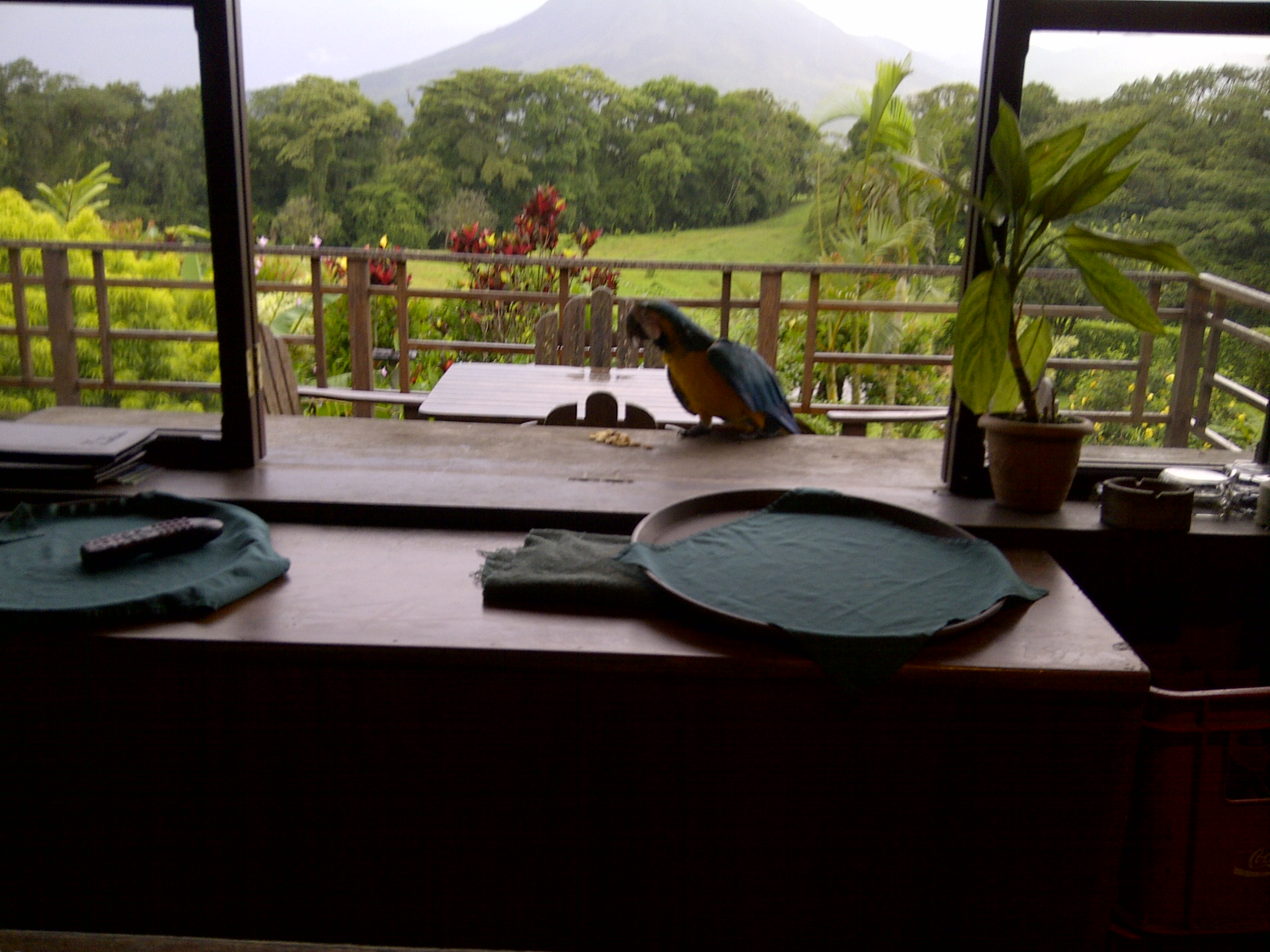

This post may be a synchro in that the first movie we saw after returning from our Costa Rica trip was Midnight in Paris, a time travel movie in the Woody Allen sense. It felt right because Costa Rica is like traveling through time. OK, so maybe that’s a stretch. But the movie is a total delight, pure Woody, from start to finish.
For anyone who has followed Woody Allen’s career since, oh, say, Annie Hall, then his usual themes are familiar to you. A fear of death, a sense that you aren’t worthy – of a relationship, a certain desire you hold, a dream. Owen Wilson plays the character that Woody used to play in his own movies. And it’s kind of eerie. He talks like Woody in his younger days, that same tone and texture, that subtext, that glorious imagination that always embraces more.
From a novelist’s point of view, the story is seamless, perfectly told, no complicated detours. Owen Wilson, the protagonist, is vacationing in Paris with his fiancée, Rachel McAdams, and her family. He’s a Hollywood scriptwriter, successful, but thinks he’s a hack who would be better off living in Paris in the 1920s when the artistic greats glommed to this city like frogs to a pond. Fitzgerald, Hemingway, Gertrude Stein, Pablo Picasso: Wilson knows that history.
And one night when he explores Paris on his own, he pauses on a particular corner and an odd car pulls up to the curb and Zelda and Scott Fitzgerald lean out the window and shout for him to join them. At that moment, he doesn’t know who they are, but he has had a lot to drink and laughs and climbs into the car with them.
Owen Wilson ends up at a party where the women are dressed like flappers and Cole Porter plays beautiful music on a piano. He meets Picasso’s mistress and falls for her. And then they all got to a bar where he meets Hemingway, who promises to give his manuscript to Gertrude Stein.
You get the idea the idea here, right? At some point, Wilson wonders if he’s lost his mind, his fiancée is sure of it. But night after night, he enters into this very magical world of time travel, and Woody Allen never explains how it’s possible. The car simply draws up to this particular corner just as the city clock chimes twelve for midnight, Wilson gets in, and is delivered to the past. The technique works beautifully.
Woody Allen is one of those artists with whom you come of age. He captures the synchronistic weirdness of a particular time and place in such a way so that when you look back over your own life, you can say, Wow, I saw Annie Hall when…. Or: I was with so and so when I saw Sleeper….
There was a time when his movies were boycotted or banned in the U.S. because he deserted his partner, Mia Farrow, and married his stepdaughter, who was ridiculously younger, and fled the U.S. Yeah, okay, so what? Politicians do this daily. For me, Woody Allen remains a quintessential filmmaker who grasps the angst behind the façade, whose films urge us to question our mass reality and ask…what if?
Info on the film is here.